
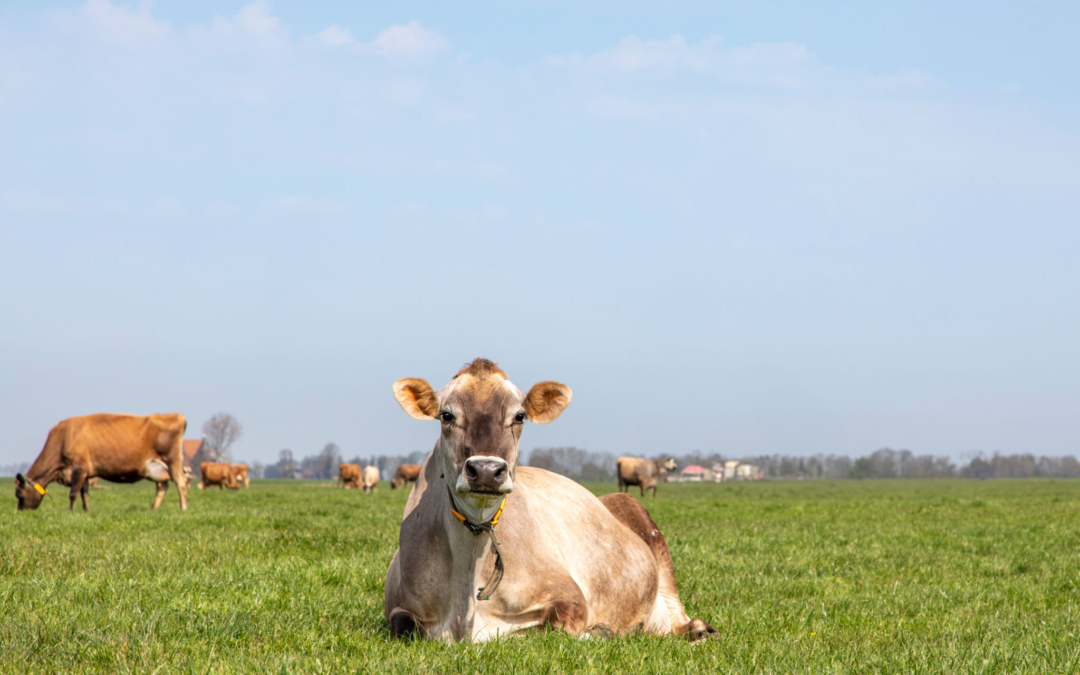
When farm manager Gareth Wyn-Evans took over running the Harvey family’s 260-cow pedigree Jersey herd four years ago, his goals were to reduce disease and lift milk yields.
Preventing milk fever
One key area of focus has been transition management. The farm has no accommodation which meant staff were not on hand 24/7 to deal with cows with milk fever.
Jerseys are notorious for milk fever, due in part to the high-component-rich milk they produce, which requires a higher mineral status at calving.
Whilst cases of milk fever were relatively low annually (about eight cases), Gareth’s preferred option is prevention rather than cure as he and the team were demoralised seeing downer cows.
Jerseys can be slow to respond to treatment and require several bottles of calcium.
Previously, transition cows were fed a partial DCAB diet alongside a dry cow mineral and 150g per head of magnesium flakes.
Working alongside our Feed Specialsit, Steve Jones, 18 months ago Gareth switched to feeding the calcium and phosphorus binder X-Zelit.
How X-Zelit works
It reduces the quantity of calcium in the small intestine, stimulating the cow to mobilise her own calcium reserves to prevent milk fever. It is much kinder to the cow than a DCAB diet because it does not acidify the cow’s blood.
X-Zelit is fed at 500g a head a day for two weeks before calving alongside grass silage, straw, a pre-calving mineral, and a balance of two blends.
Since switching to the binder, clinical cases of milk fever have been non-existent. Everything is up and calved much quicker and the farm doesn’t get retained cleansings and has very low rates of ketosis, perhaps one per block.
The binder costs £1.70/cow/day, but the lower incidence of transition disease makes it a sound investment.
Improvements to the dairy herds’ efficiency
Improved transition management has underpinned an improvement in milk yields – since 2019, these have risen by 30% to over 5,000 litres. Meanwhile, cows are maintaining high levels of constituents (6.27% butterfat and 4.08% protein).
Improved transition cow management and feeding have also aided advances in fertility. The calving period has been cut back from 18 weeks to 11. In the spring mob, 93 calved in February out of 130 cows.
Cows are hitting peak yield much quicker and are doing 30+ litres within six weeks of calving.
Contact us
Speak to your Harpers Feeds Specialist to find out how X-Zelit can work for your dairy herd.


